
Every report, from the same record.
EPR filings, Scope 3, avoided emissions and the claims on your pack all pull from one audited record, so they agree with each other and with your auditor.
Two states are already billing. California is next.
Disconnected records leave your team piecing together what happened after someone asks. That creates extra work and makes material claims harder to substantiate. Keeping evidence connected addresses the problem at the handoff, not just in the final report.
Per pound, by format. Its bonuses need a third-party-reviewed LCA that your custody data feeds.
Credits of up to 10% of the fee go only to evidenced performance.
SB 54 fees start, with a PCR bonus for certified pounds that reach the SKU.
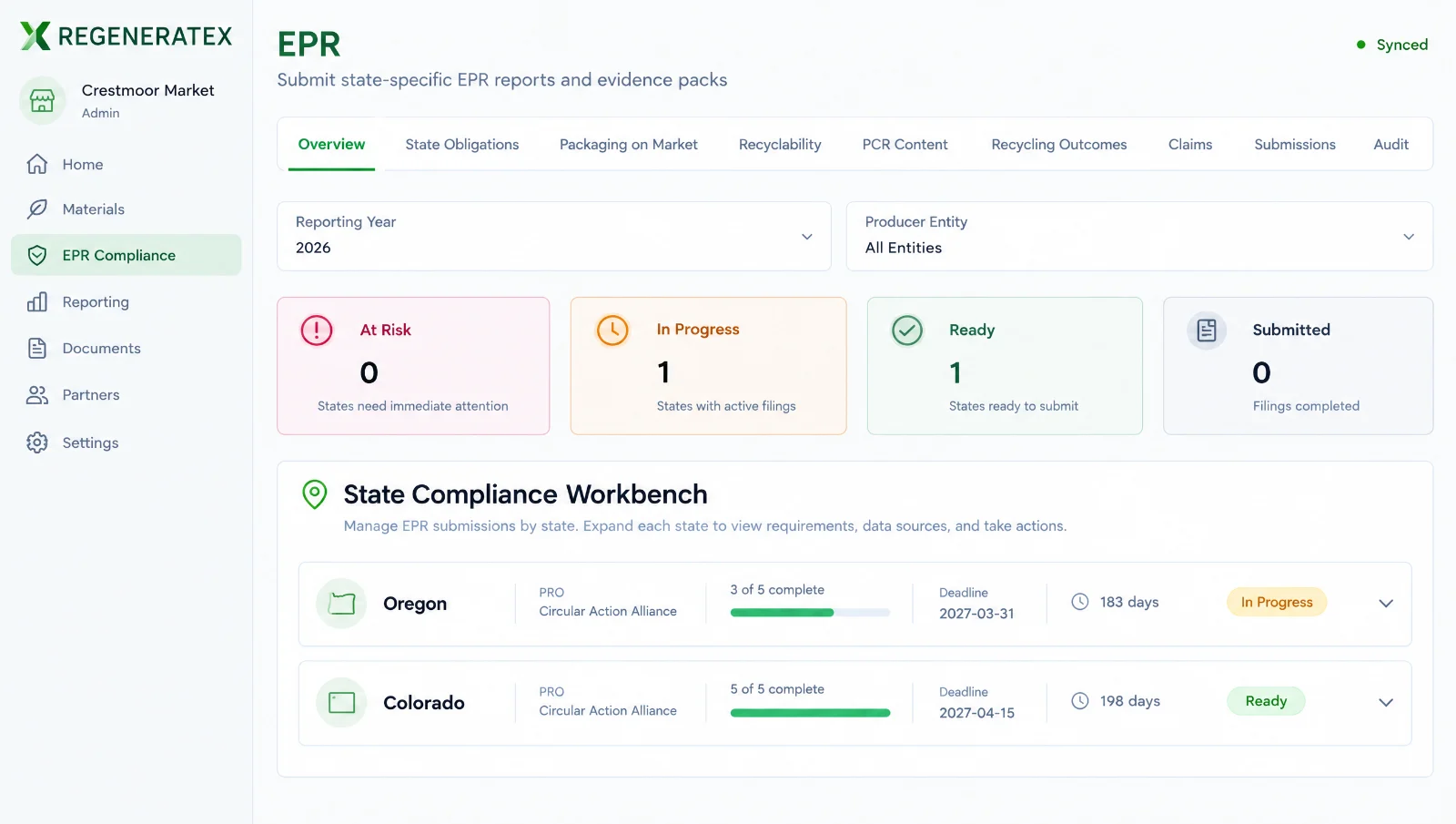
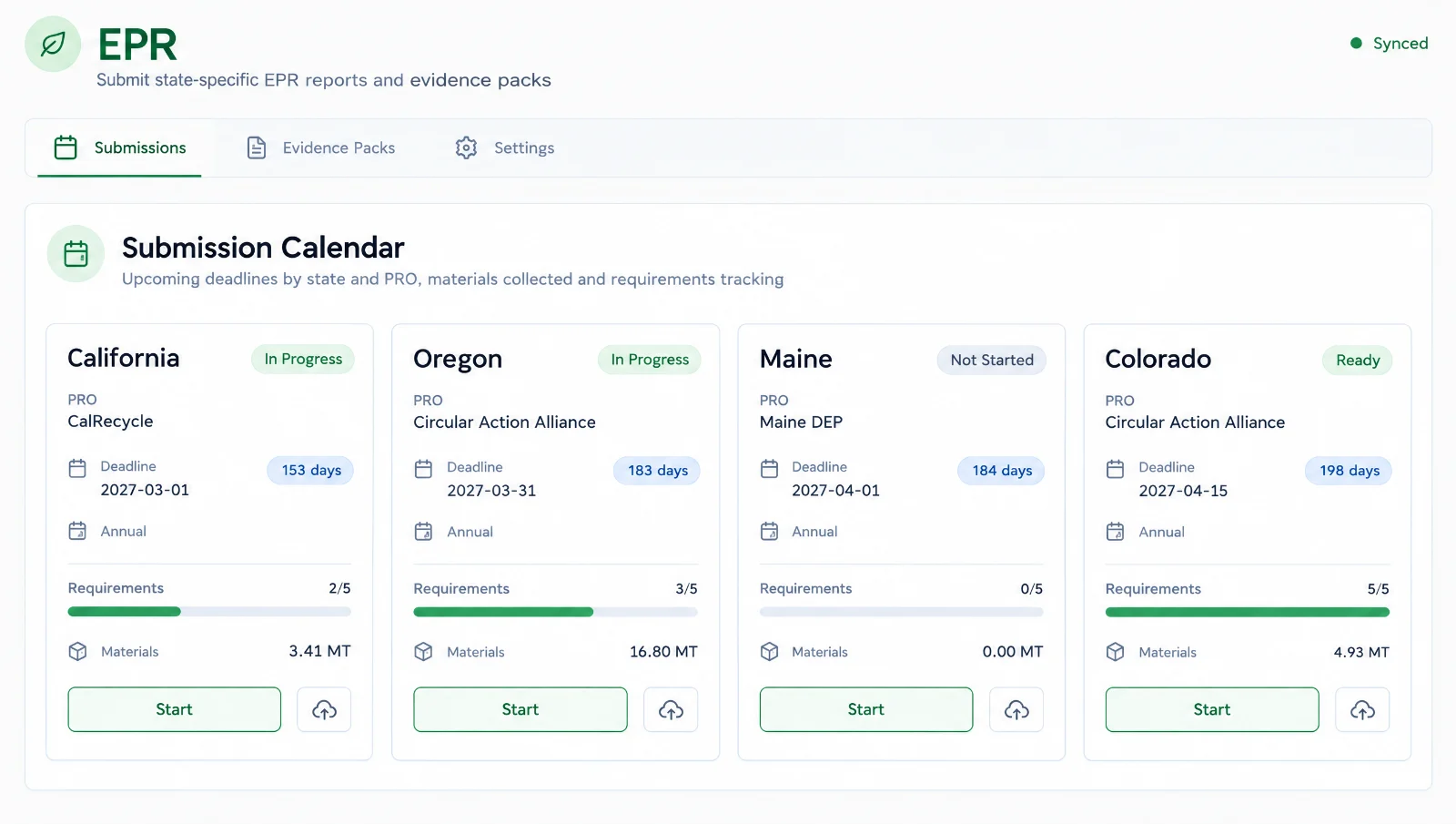
No EPR in your state yet? Private-label packaging becomes obligated the moment it ships into any of the seven EPR states, and green-claims rules apply everywhere.
Verify Oregon fee against the CAA PDF before launchShoppers pay for proof, and punish its absence.
Tell your customers the truth, and prove it.
Shoppers reward sustainability they believe and punish claims that do not hold. The record gives a retailer or brand audit-grade proof to publish, to message and to stand behind.
- 01Report it
Sustainability reports and disclosures built from real-time, audit-grade data, not estimates.
- 02Say it
Marketing, packaging and site claims drafted from the record, so every line has proof behind it.
- 03Defend it
When a customer, reporter or regulator asks, the answer is the audited record, not a press release.
- 04Share proof, not secrets
Partners confirm the facts without exposing prices, suppliers or volumes, and stay compliant doing it.
Illustrative. Figures on the screen are sample data.
What is Scope 4?
"Scope 4" is the informal name for avoided emissions, first floated by the World Resources Institute in 2013. The working rulebook is the WBCSD Guidance on Avoided Emissions, version 2.0, published July 2025.
The emissions your solution helps others avoid, compared with what would have happened without it. Recycled PET resin, for example, carries about 60 to 67% lower greenhouse gas emissions than virgin resin.
Never a cut to your own footprint. The GHG Protocol requires avoided emissions to be reported separately from Scope 1, 2 and 3, and never netted against a climate target.
Big buyers have started paying for verified low-carbon materials. Under SBTi's new net-zero standard, in effect February 2027, these purchases count only as a contribution, and only with a serialized, third-party-assured record.
Where REGENERATE X fits: every one of these deals needs per-lot proof of what material, how much, and where it went. That record is what REGENERATE X builds.
Sources: WRI (2013) · WBCSD Guidance on Avoided Emissions v2.0 (2025) · GHG Protocol Scope 3 FAQ · APR / Franklin Associates (2018) and NAPCOR (2020) resin LCAs · SBTi Corporate Net-Zero Standard v2.0 (2026)The biggest buyers now pay for verified low-carbon materials. Recycling just joined the list.
On September 22, 2026, Meta signed a three-year deal to buy environmental attribute certificates from MacroCycle, a U.S. PET recycler, to fund its first plant. Every deal like it needs one thing: a record of who owns the carbon on each pound. For recycled plastic, no registry exists yet.
How it is reported: three ledgers, never one total.
Avoided emissions, often called Scope 4, sit on their own ledger. They are reported separately and never netted against Scope 1, 2 or 3.
Disclosure view · one brand · FY2027 Illustrative
Recycled resin bought with a supplier-specific footprint.
No physical link to your product. A contribution claim, not a Scope 3 cut.
Virgin resin that was never made. Reported separately, never netted.
The record carries weights, yield and processing per lot.
The record carries custody from the store bin to the processor.
The record carries material, grade and destination per lot.
The record is built to show who owns the carbon on each pound.
We track the pounds. The record is built to prove who owns the carbon.
Find the value your supply chain already holds.
We walk your own records through the platform and show you the gaps, the proof and the dollars.